

Mindful Pet Daily is reader-supported: when you buy through links on this page, we may earn a commission at no extra cost to you. Learn more
If your dog empties every puzzle in two minutes and then looks at you for the next one, the toy is too easy, not your dog too clever. The fix is to move up to level 3 and level 4 puzzles, the ones that need two or more different moves in the right order, and to rotate them so your dog can’t memorise the answer.
Below are six picks for dogs who have outgrown beginner puzzles, what each one is best for, who should skip it, and what owners report after living with them.
In a hurry? Jump to a pick: Hardest · A whole meal · Best budget · Budget sequence · A different design · For chewers
Quick picks
| Pick | Puzzle | Level | Best for | Shop |
|---|---|---|---|---|
| Hardest | Nina Ottosson MultiPuzzle | 4 (expert) | Dogs who beat every level 3 puzzle | Amazon |
| A whole meal | Nina Ottosson Challenge Slider | 3 | Feeding breakfast or dinner as a puzzle | Amazon |
| Best budget | Nina Ottosson Dog Casino | 3 | Drawers and locks, kibble or treats | Amazon |
| Budget sequence | Nina Ottosson Dog Twister | 3 | Learning “unlock first, then slide” | Amazon |
| A different design | TRIXIE Move-2-Win | 3 (TRIXIE’s scale) | A change of brand and moves for rotation | Amazon |
| Chewers and hard mode | KONG Classic, stuffed and frozen | none | Dogs who chew plastic puzzles to pieces | Amazon |
How puzzle levels work
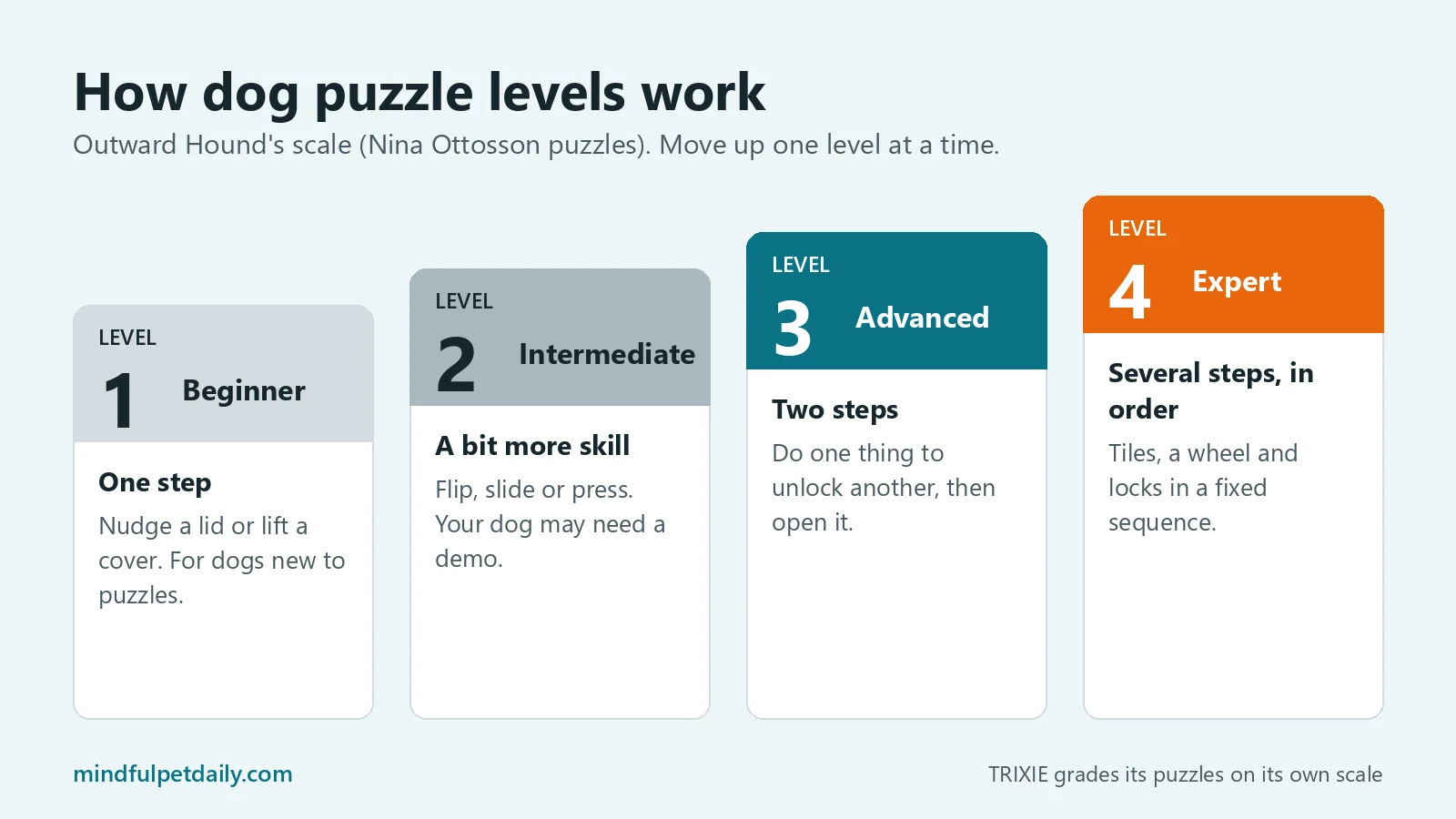
Most puzzle makers grade their toys by difficulty. Outward Hound, which makes the Nina Ottosson range, uses four levels:
- Level 1: one step, such as nudging a lid or lifting a cover.
- Level 2: a little more skill, such as flipping, sliding or pressing.
- Level 3: two-step solutions. The dog has to do one thing to unlock another.
- Level 4: expert. Several steps in a fixed order (currently the MultiPuzzle).
TRIXIE grades its puzzles on its own scale, so a TRIXIE “level 3” and a Nina Ottosson “level 3” are not exactly the same difficulty.
A smart dog is ready for level 3 when it solves level 2 puzzles quickly and without help, keeps trying when the first move doesn’t work, and is motivated by food.
The picks
Nina Ottosson MultiPuzzle: the hardest

At a glance: Level 4 (expert) · 28 hidden compartments, about 1 cup of kibble · Sliding tiles, a wheel and add-on locks · Hand wash · Not for chewers
Level 4 (expert). Treats hide in 28 compartments around the outside and in the center. Your dog has to slide tiles, turn a wheel and get past the orange locks, in the right order, before the treats are reachable. It holds roughly a cup of kibble, so it can serve a small meal, and the locks are optional, so you can leave them off while your dog learns.
- Best for: dogs who already finish level 3 puzzles quickly.
- Skip it if: your dog hasn’t mastered a level 3 puzzle yet (start with one of the level 3 picks below), or your dog chews toys. The maker says not to let your dog chew the game or its pieces.
- What owners report: plenty of praise for keeping clever dogs busy, alongside complaints that determined dogs chew or break the plastic pieces.
Nina Ottosson Challenge Slider: a whole meal

At a glance: Level 3 · 24 compartments, about 1 cup · Wet or dry food · Sliding tiles · Doubles as a slow feeder
Level 3. A tray of 24 compartments under sliding tiles. It holds about one cup of wet or dry food (a full meal for many small dogs, part of a bigger dog’s ration), so it doubles as a slow feeder at mealtime.
- Best for: dogs who eat fast, and owners who want a puzzle that uses the daily food ration rather than extra treats.
- Skip it if: your dog chews plastic, or you want a puzzle with several different moves. This one is mostly sliding, so some fast learners find it easy once they get the idea.
- What owners report: a popular, long-lasting choice for many dogs. The common complaints across this range are chewed pieces and boards that slide around the floor.
Nina Ottosson Dog Casino: best budget

At a glance: Level 3 · 6 drawers with bone-shaped locks · About 1 cup of kibble or treats · Wash with warm water and soap
Level 3. Six drawers, each held shut by a bone-shaped lock. Your dog has to turn the bones to unlock the drawers, then pull the drawers out. It holds about a cup of kibble or treats, and the maker says to clean it with warm water and soap between uses.
- Best for: a first level 3 puzzle at a budget price, and dogs who like to use their paws.
- Skip it if: your dog chews. Owners describe drawers and covers with chew marks, and the bones and drawers are small enough to need supervision.
- What owners report: a good step up from level 2, with the usual warning about strong chewers.
Nina Ottosson Dog Twister: budget sequence

At a glance: Level 3 · 9 compartments · Lift the tabs, then slide the blocks · About 1 cup of kibble or treats
Level 3. Nine compartments in blocks that slide around a round board. Built-in white tabs lock the blocks; your dog has to lift the tabs first, then slide the blocks to reach the treats. That “unlock, then move” order is exactly what level 3 is about.
- Best for: teaching a two-step sequence, and rotating with the Dog Casino so neither gets stale.
- Skip it if: your dog chews or tends to carry puzzles off. The tabs and blocks are plastic and small enough that a chewer can damage them, so supervise and check the board after each session.
- What owners report: good value and a real challenge at first; some dogs work it out quickly.
TRIXIE Move-2-Win: a different design
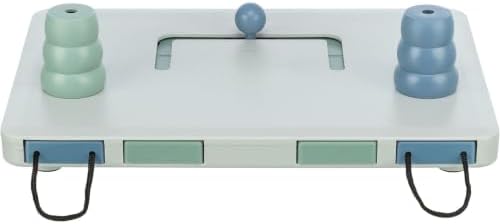
At a glance: Level 3 on TRIXIE’s scale · Lift cones, pull drawers, push a slider · Rubber feet · Dishwasher safe (maker)
Level 3 on TRIXIE’s scale. One board that asks for several different moves: lift two cones straight up, tug drawers open by their loops, and push a slider knob along a path to open two more drawers. Using a second brand matters more than it sounds. A dog that has learned how Nina Ottosson puzzles work has to think again with a different design.
- Best for: rotation. Swapping between two brands keeps the challenge fresh for longer.
- Skip it if: your dog chews plastic. The two cones lift out, so put them away after play.
- What owners report: a fun brain game for clever dogs. Despite the rubber feet, the most common complaint is that it slides around while the dog works, so a mat still helps.
KONG Classic, stuffed and frozen: for chewers, and a hard mode

At a glance: No difficulty level · Natural rubber, one solid piece · Sizes for small to giant dogs · Freeze it for hard mode
No difficulty level. A single piece of tough rubber you fill with food. On its own it’s easy. Packed tightly with soaked kibble and frozen overnight, it can take a dog much longer to empty, which makes it the “hard mode” of this list and a sturdier choice than plastic boards for dogs who chew. KONG makes the red Classic for average chewers; for the strongest chewers it makes the black KONG Extreme.
- Best for: dogs who chew plastic puzzles to pieces, and as the frozen option in a rotation.
- Skip it if: your dog is a determined shredder of rubber (look at the KONG Extreme instead). No toy is chew-proof, so check it for damage and replace it at the first tear. Pick the right size: KONG says the largest ring should be bigger than the back of your dog’s mouth, and to size up if in doubt.
- What owners report: widely recommended for durability, including by owners of heavy chewers, with some dogs simply losing interest.
How to make any puzzle harder
A clever dog stops being challenged by a puzzle once it remembers the answer. Before you buy another one, try these:
- Rotate. Keep two or three puzzles and swap them every few days. Mixing brands helps.
- Close everything. Lock every lid, drawer and tab, even the ones the instructions leave open.
- Hide fewer treats. Fewer rewards in more compartments means more searching.
- Freeze it. Wet food or soaked kibble frozen into a puzzle or KONG makes it slower.
- Use the daily ration. Measure a part of the day’s food into puzzles instead of adding treats, so mental work doesn’t become extra calories.
Ready to choose? Back to the quick picks
Challenge or frustration?
A good puzzle is hard but solvable. Watch for the difference:
- Challenge: your dog keeps trying different moves, takes short breaks and comes back, and looks relaxed when it gets a treat.
- Frustration: barking at the puzzle, chewing or biting it, flipping it over, walking away and not coming back, or panting and pacing.
If you see frustration, make it easier: open a few compartments, show the first move, or go back one level for a while. The goal is a dog that enjoys working, not one that gives up.
Safety
- Supervise. These are not toys to leave a dog alone with.
- Put it away when the treats are gone, so the puzzle doesn’t turn into a chew toy.
- Check for damage before each use, and throw away anything cracked, split or missing a piece.
- Use a non-slip mat under board puzzles so they don’t slide away from your dog.
- Chewers: choose the KONG over plastic boards.
- Food: use your dog’s normal food, and check any fillings for ingredients that are unsafe for dogs, such as xylitol (sometimes listed as birch sugar).
Who should skip puzzle toys
Puzzle toys are enrichment. They are not a fix for health or behaviour problems. If your dog shows sudden changes in behaviour or appetite, self-injury, severe distress when left alone, or aggression, talk to your veterinarian or a certified behaviour professional first. Dogs with painful teeth or jaws, or on a restricted diet, may need a different kind of enrichment; ask your vet.
What we left out, and why
- TRIXIE Flower Tower: several owners report the pegs and knobs coming out easily and dogs trying to eat them.
- TRIXIE Skills Loop (level 4): too new to have a meaningful track record yet.
- TRIXIE Chess and Mini Mover: not reliably available at the time of writing.
- Beginner (level 1 and 2) puzzles: this guide is for dogs who have already outgrown them.
FAQ
Are puzzle toys good for dogs?
For most dogs, yes. They turn mealtime into problem-solving, which uses a dog’s natural foraging and searching behaviour. They work best alongside walks, play and training, not instead of them, and always with supervision.
What level should a smart dog start at?
Start one level above what your dog solves easily. If it finishes level 2 puzzles quickly and without help, try a level 3. Move to level 4 only once level 3 puzzles are solved reliably.
How long should a puzzle take?
There’s no fixed time. If your dog empties a puzzle in a minute or two every time, it needs a harder one or a rotation. If your dog gives up or gets frustrated, make it easier.
Can puppies use level 3 puzzles?
Start puppies on easier puzzles and supervise closely, since puppies chew more and can swallow small pieces. Move up once your puppy reliably solves the easier level.
How we research
This guide brings together manufacturer information, how each maker grades difficulty, and patterns in what owners report. More in How We Review.
Last updated: October 29, 2026